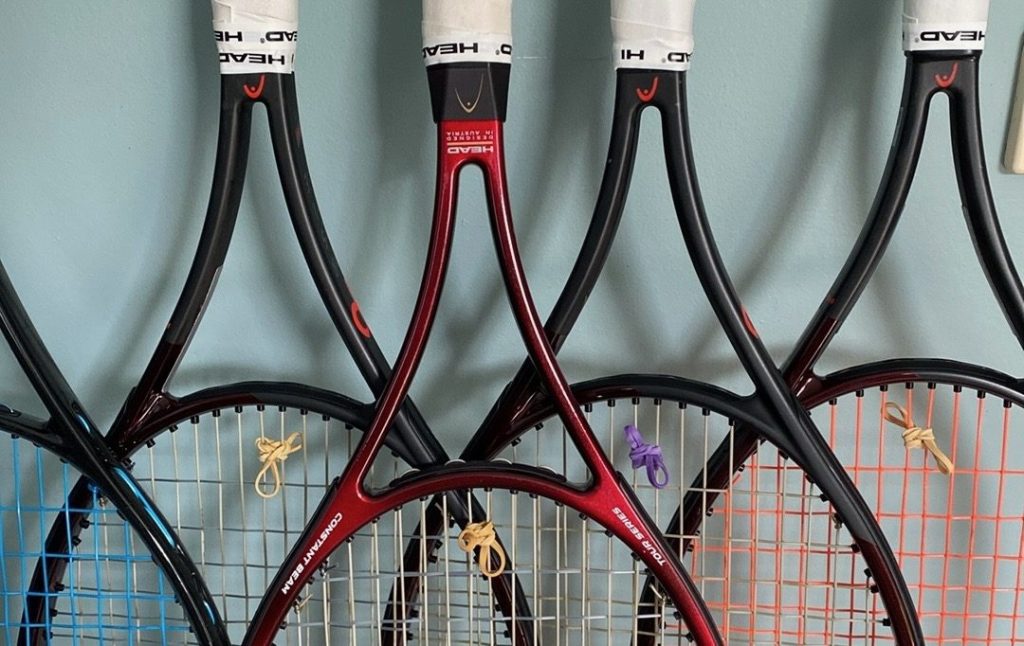
Tennis racquet customisation enables you to gain more spin, power, and comfort. This essentially comes down to adding weight to your racquet, but as with everything, there are trade-offs. The challenge is to find the right trade-off that works for you, your physical conditioning, technique, and personal preference.
Below is my summary of what to measure and how to apply weight to your racquet in search of more spin, power, and comfort. I started tinkering with my racquets to improve the feeling (there is more to tennis than just winning or losing). It is also fun to experiment.
The basics
There are three measurements, that you need to know about your racquet: 1) Static weight, 2) balance point, and 3) swing weight. There are other measurements such as twist weight and recoil weight, but they are well and truly into nerd territory 🤓.
Static Weight
Static weight is the total weight of your racquet as measured using the kitchen scales. The weight printed on the racquet frame is the weight without strings, overgrip, or dampener. These will typically add 15-17 grams for strings (16×19 are lighter than 18×20 strings patterns because there is less string), 5-6 grams for an overgrip, and maybe 1 gram for a dampener (depending on its size etc).
Racquet manufacturers will print the intended weight on the frame of the racquet, but you will most likely find, that the actual weight of your racquet can vary a few grams either way. Racquets are generally +/- 5 grams within the printed weight.
Unfortunately, this still means that two racquets – same brand, model and year – can have 10 grams in difference. For example, the Wilson Blade 100 v9 has 300 grams printed as its weight, but the actual racquet can be somewhere between 295 and 305 grams. And you will notice that…
How to measure static weight
The static weight is what you feel, when you hold the racquet pointing straight down. The best way to measure static weight is to place your racquet on the kitchen scales. And no, bathroom scales are not accurate enough.
Static weight trade-off
In general, a heavier racquet will feel more stable than a lighter racquet, although this will also vary depending on head size, beam thickness (aka the “mold”), and the construction material. If the racquet is too heavy, then you’ll find it difficult to keep up the pace. The saying used to be “play with as heavy a racquet, as you can manage”, but I’m not sure that still applies with today’s heavy top spin game.
Balance point
The balance point is defined, as the point on the racquet where it is perfectly balanced. The confusing part is that balance points are listed as two different numbers: 1) the distance from the middle of the racquet (e.g. 2 pts head light), and 2) the distance from the bottom of the handle (e.g. 33 cm). Same balance, difference measurements.
In the below picture, the yellow line is the half way distance between the top and bottom of the racquet, while the red line illustrates the point where the static weight is equally balanced – aka the balance point.
- Head light balance = red line is closer to the grip than the yellow line.
- Head heavy balance = yellow line is closer the grip than the red line.
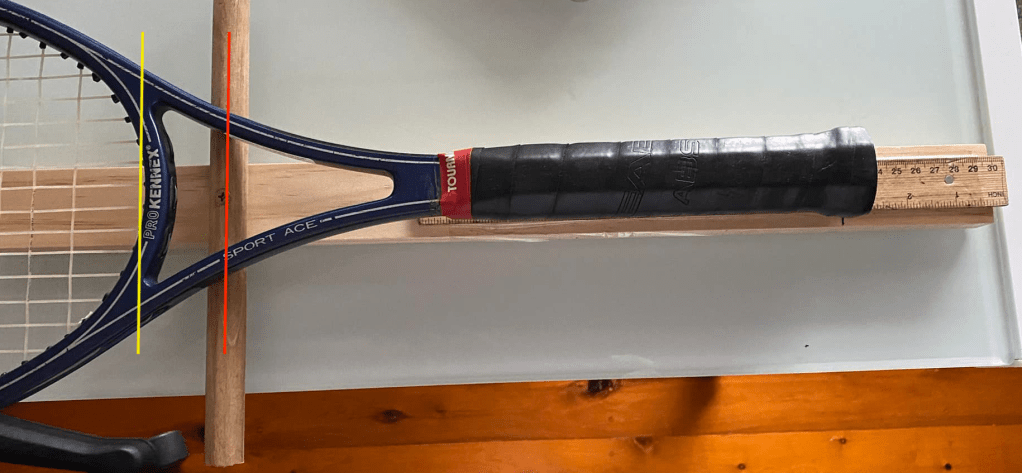
How to measure the balance point.
Balancing the racquet on your finger won’t give you a good measurement, but it is not difficult to make your own balance point measuring device. A round stick mounted as shown in the picture with a measuring tape (or ruler) aligned to measuring the distance from the middle of the stick will do just fine.
A standard tennis racquet is 27 inches long (68.58 cm) and the mid point is therefore 13.5 inches (34.29 cm) (yellow line). For example, the Wilson Blade 100 v9 is listed with a balance of 13 inches or 33.02cm (red line to bottom of handle) and 4 points Head Light (where 1 point is 1/8 inch) aka 0.5 inches between the yellow and red line. Same balance, two measurements. Clear as mud? Really not sure why we have to have two different measurements for the same thing…
Balance Point Trade-off
The balance point combined with static weight will influence how easy it is to move the racquet with your wrist (or “whipability” as Troy from Tennis Warehouse calls it). Modern technique relies on wrist action to create spin. An easier to move racquet is also quicker to adjust for last minute ball flight variations including volleys. The balance point may influence your game more than you realise.
You feel the balance point, when you hold the racquet (as if you are playing) and move the racquet up and down using only your wrist.
Typically, the heavier racquets have lower balance points to avoid the racquet feeling like a sledge hammer and overly straining your wrist. So as you start to increase the static weight of your racquet, you may need to pay attention to the balance point and potentially bring it down.
Note that a low balance point doesn’t automatically equal low power. This is where the next measurement comes in.
Swing weight
Manufacturers generally don’t provide a swing weight measurement, but Tennis Warehouse (TW) will provide an average of their measurements. For example, TW has listed the Wilson Blade 100 v9 as having an average swing weight of 322 grams. As with the static weight, the swing weight will vary slightly for the actual racquet that you buy.
Swing weight is a way to gage how heavy the racquet feels when swinging it. You feel the swing weight, when you hold the racquet (as if you are playing) and swing it from side to side using the lower part of your arm.
How to measure the swing weight
Tennis Warehouse provides a step by step guide, but I found it challenging to get consistent results. If you have an iPhone, then there is an app called Swing Tool to help you with the measurements. It does seem to make the measurements significantly more consistent. This will allow you to compare your racquets and measure the changes, as you add weight to your racquets. However, if you want precise measurements, then you need a machine like the HEAD 4 in 1 Diagnostics Centre. Or find someone who has one…
Unfortunately, you can’t assume, that two identical racquets (same brand, same model, same year) with identical static weight and balance will have the same swing weight! The manufacturing process doesn’t ensure, that the material is distributed consistently. The mass in one racquet can be more polarised, i.e., more of the weight is closer to the top and bottom, and the other racquet might have more of its mass closer to the balance point. The more polarised racquet will have a higher swing weight than the lesser polarised racquet.
Swing weight trade-offs
Higher swing weight provides more mass behind the ball = more power and more stability. Plain and simple, as long as you can maintain the same racquet speed. However, more power requires more control and spin to keep the ball inside the court placing higher demands on your wrist, hence the recommendation to lower the balance point slightly as you increase the swing weight. But remember that racquets can be too heavy, so you’ll quickly find an upper limit to this power generating trick 🤓
Most adult racquets are designed for the 310-330 gram range. Most club players will find 330+ grams too demanding over a 2+ hour match, especially if you have a more modern technique. The “too heavy” racquet might feel fantastic during the first half an hour, while you are fresh, to only later start to feel more and more like a sledgehammer. Obviously this depends on your physical conditioning and playing style.
Federer’s Pro Staff RF97 Autograph racquet is around 335 grams and significantly lower than Djokovic and Nadal’s 360-370 grams swing weights. By contrast, Alcaraz’s swing weight is in the mid 320 gram range. This illustrates that there are no right or wrong or better. Just what you like and what suits your game.
Customisations
As mentioned in the beginning, tennis racquet customisation is basically adding weight to your racquet at different points. Lead tape or tungsten tape are the main ways to add weight, but overgrips and silicone can also be used.
“The hoop” is an expression referring to the inside of the head of a tennis racquet, and “the hoop at 12 o’clock” refers to the very top of the racquet head furthest away from the grip.
The hoop at 12 o’clock: Using the thinner variation of the Gamma lead tape or TW tungsten tape, adding weight at 12 o’clock has the highest impact in swing weight, because the location provides the highest weight amplification. 2 grams will roughly bring the swing weight up by 8-10 grams, yet static weight and balance will only increase marginally. No prize for guessing the static weight increase…
You will feel more power and an improved feeling of “plough through” – the sensation of the racquet going through the ball path. If you can still swing the racquet properly, then this is useful against opponents with a heavier ball. If your opponent hits hard, then you might find yourself rushed and struggle to time the ball, as the added weight may slow the racquet down.
I’d only suggest this for racquets with a low swing weight, e.g., Dunlop CX 200, or if you are physically strong enough to maintain the racquet swing speed over a full match.
The hoop at 3 and 9 o’clock: 1-2 grams on either side of the hoop will bring up the swing weight, as well as improve the overall feeling of stability. This will add power (due to higher swing weight), but also increase the feeling of a bigger sweet spot. A bigger sweet spot will add some forgiveness to the racquet, as you don’t need to be as precise with your ball contact. This is the idea behind the small bumps inside of the hoop of the Wilson Pro Staff racquets.
Inside the throat: Adding weight to the throat of the racquet got plenty of media attention after Carlos Alcaraz did it to his racquet before the AusOpen 2025. The benefits are mainly from the increase in static weight without changing the balance point or a dramatical increase in swing weight (it will increase slightly). This will add some power and stability without changing how the racquet plays and feels. Here’s Tenncom’s excellent analysis: https://www.youtube.com/watch?v=x5gmwyXFojY&t=80s
For racquets with a thinner beam profile (sub 22mm) or a low flex (65 RA or lower), you may find that adding weight to top of the frame will make it flex more. Adding a bit of weight to throat can reduce the flexing.
Adding weight to the grip: The simplest way to add weight to the grip area is by adding an overgrip. An overgrip weighs about 5 grams. If you want to add more weight, or if the overgrip makes the grip too thick, then use Gamma’s wide lead tape and install it under the main grip material (it will generally re-stick unless it is old, but then you should probably change it regardless). Both options will lower the balance point and increase manoeuvrability without reducing swing weight. Your racquet will not become less powerful, but the increased manoeuvrability can make the racquet easier to swing. An increase in the swing speed will increase power and spin.
Alternatively, you can add silicone inside the handle of your racquet, but get a professional to assist, as you don’t want the silicone to run into the rest of the racquet. Some racquets, e.g. most Tecnifibre racquets, are filled with foam, so it won’t be possible to add silicone.
You can lower the balance point too far, make the racquet come through faster than expected, and negatively impact your ability to time the ball.
My own personal racquet customisations
A customised tennis racquet is a personal thing based on a range of factors. Does my customisations make me a better tennis player? Most likely not, but they have improved my general racquet enjoyment.
My current racquet is the HEAD Prestige MP 2021. The racquet is a great all rounder similar to the Wilson Blade 98 and the new Tecnifibre Tfights S versions. In stock form, the racquet specs with strings are (according to TW):
- Static weight: 326 grams
- Balance point: 33 cm
- Swing weight: 334 grams
The actual swing weight of my racquets are a few grams lower (330g), but it is already quite high so no need to add weight in the hoop.
The racquet felt very stable and plenty powerful for hitting ground strokes, but for all other strokes, I felt it could be better. After many trial and errors, I have settled on the following additions:
- 4 grams under the main grip plus an overgrip adding a total of 9 grams
- 4 grams in the throat
Final specs are:
- Static weight: 343 grams
- Balance point: 32.5 cm
- Swing weight: 330 grams
The main benefits are:
- Big lift in stability across all shots due higher static weight
- Increased comfort as the racquet returns more energy to the ball than my arm. This is mainly due to the higher static weight, but the lower balance point also makes it easier for me to time the ball.
- Improved my serve – not entirely sure why, but I feel much more comfortable serving with a racquet with a higher static weight and a lower balance point.
This is obviously specific to my racquet of choice, my personal preference, and my technique (which isn’t overly modern).
My main advice is to have a go, try stuff, and have fun 🎾😎

 Tennis dad
Leave a reply to Tips & tricks to make your tennis more enjoyable – Tennis dad Cancel reply